Everyone Says Venture Is Consolidating. Nobody Says Why.
When I was studying for my CAIA and working at Cambridge Associates, CIOs and the CAIA curriculum were both yelling about fund persistence. Fast forward to now and the primary narrative we hear about is "consolidation." Everything is consolidating — deal count, dollars, VCs. But consolidation is really just a symptom of a few bigger motions in the market, and one of them is actually persistence.
Persistence is a boring word for a simple idea: does a GP's next fund perform like their last one? If it does, an allocator's job gets a lot easier. You don't have to underwrite a strategy deck, you underwrite a track record. That's the whole reason "top quartile" became the industry's favorite two words.
So I went back to the paper everyone cites on this — Harris, Jenkinson, Kaplan and Stucke's Has Persistence Persisted in Private Equity? It runs 1,329 VC funds and roughly 900 buyout funds through Burgiss cash-flow data, vintages 1984–2014, valued through June 2019.
The first time I read it I came away thinking persistence had faded after 2000. Turns out I had it half right, and the half I got wrong is the interesting one.
It faded for buyouts. In venture it never left.
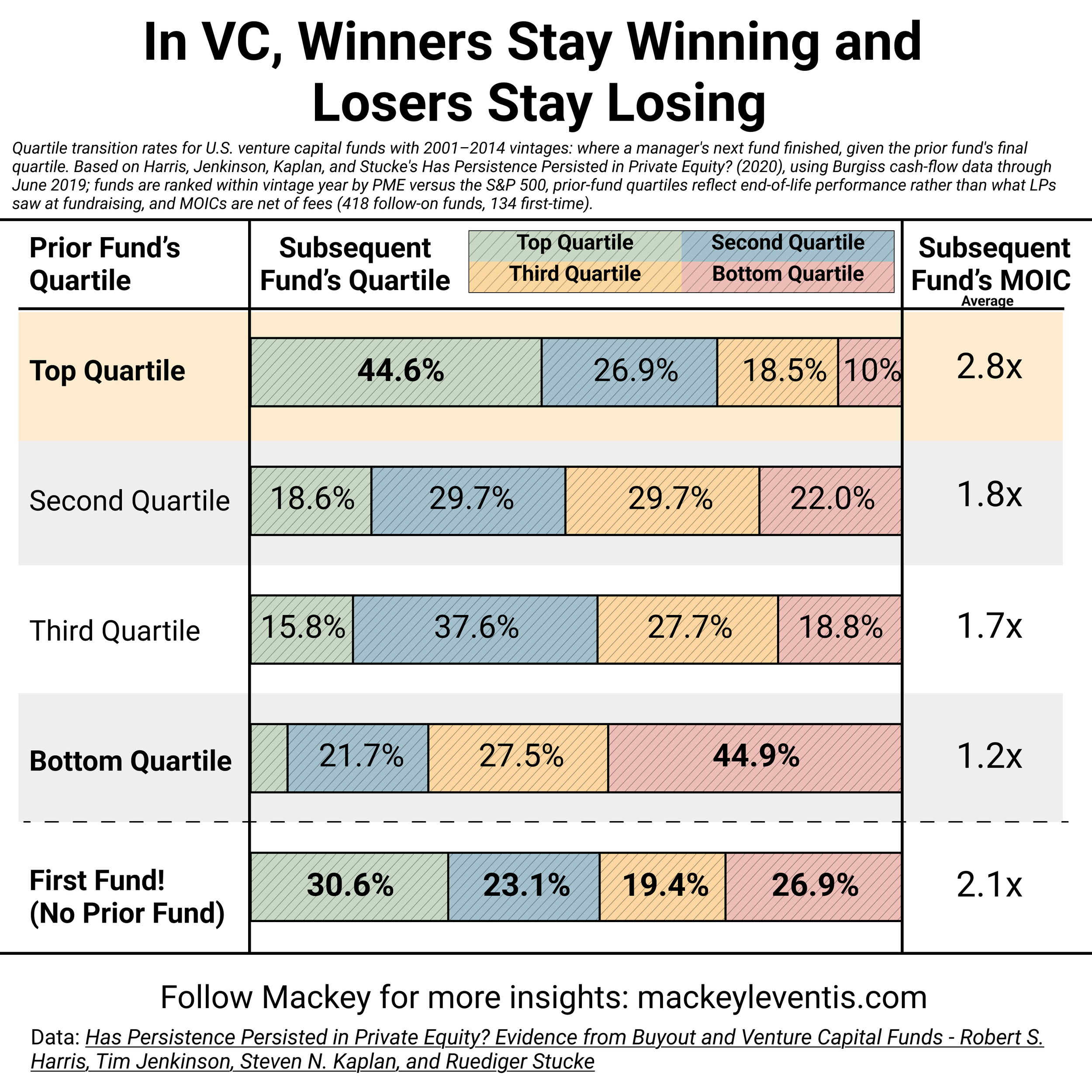
Here's post-2000 US venture, sorting managers by how their prior fund ultimately finished:
Coming off a top-quartile fund, the next fund landed top quartile 44.6% of the time. Chance alone would give you 25%.
Coming off a bottom-quartile fund, the next fund landed bottom quartile 44.9% of the time.
Average MOIC on those two groups: 2.8x versus 1.2x. In PME terms, 1.57 versus 0.69 — one group roughly doubled the S&P 500, the other lost to it badly.
Winners stay winning. Losers stay losing. That part of the CAIA curriculum survived.
The catch nobody mentions
Those numbers sort managers by their prior fund's final performance. Which is a problem, because nobody has that number when they're deciding. VC funds run 12+ years and GPs come back to market around year 3 or 4, so at re-up time you're staring at interim marks, not outcomes.
The authors do something I haven't seen elsewhere: they redo the whole thing using the prior fund's performance as of the fundraise date. The information you'd actually have in the data room.
Venture persistence survives, but it gets humbler. Post-2000, a manager whose prior fund was showing top-quartile numbers repeated top quartile 30.1% of the time instead of 44.6%. Still better than the 25% coin flip, and the PME spread still works — 1.20 for the top group versus 0.91 for the bottom. The signal is real. It's just weaker than the hindsight version everyone quotes.
Now do the same thing to buyout, and the floor gives out.
Post-2000, buyout managers showing top-quartile numbers at fundraise went on to produce a top-quartile fund 23.9% of the time — slightly worse than chance. Managers showing bottom-quartile numbers did it 27.3% of the time. Better. And the average PMEs across all four groups: 1.19, 1.19, 1.12, 1.20.
That's not weak persistence. That's a flat line. Whatever you paid up for when you backed a "top quartile" buyout GP post-2000, you did not get it.
The first-fund wrinkle
The other row worth staring at is the managers with no track record at all. Post-2000 first-time venture funds landed top quartile 30.6% of the time, bottom quartile 26.9% — basically chance, with a slight barbell on both ends. Their average MOIC was 2.1x, second only to top-quartile re-ups and ahead of everyone else.
Maybe that's luck. Maybe it's small-fund math, where one good exit moves the whole multiple. But it means a first fund was a better bet than re-upping with anyone below top quartile, which is not how the market actually allocates.
Where the consolidation shows up
Here's the part that connects back to the narrative.
In the venture sample, 219 funds had a top-quartile predecessor. Only 118 had a bottom-quartile predecessor. Those groups should be the same size — quartiles are quartiles. They aren't, because bottom-quartile managers frequently don't get a next fund at all. They exit the dataset by failing to exist.
It's starker at fundraise. Only 11% of venture funds with a rankable prior fund were showing bottom-quartile numbers when they raised. In post-2000 buyout, 9%. Managers with bad interim marks mostly don't come back to market.
That is consolidation. It's just measured from the inside. The industry isn't concentrating because LPs suddenly got timid — it's concentrating because in venture the signal LPs are following actually works, so the money follows it, and the managers who lose the signal don't get another turn.
Why venture keeps it and buyout lost it
The paper documents the divergence. It doesn't fully explain it. So here's my theory, offered as a theory.
It comes down to who's choosing.
When a business owner sells their company to a PE firm, they don't care about that firm's returns. If anything, a buyer with top-decile returns is a warning sign — those returns came from somewhere, and the somewhere is often the seller's side of the table. Sellers optimize for price and terms. Any competent buyer with committed capital clears the bar.
A founder is in a completely different position. They're not exiting, they're along for the ride, and they're going to be stuck with this person for a decade. So founders chase the best name they can get. The best names see the best deals first, which produces the best outcomes, which strengthens the name. It's a flywheel, and it only spins in a market where the person accepting your money cares who you are.
Sellers pick the highest price. Founders pick the best partner. That asymmetry is the most plausible reason I've got for why one asset class kept persistence and the other didn't.
So what do you do with this
If you're an allocator: the track record signal in venture is real, it's just worth less than the pitch decks imply. Roughly 30% odds of a repeat, not 45% — and if someone is quoting you persistence stats built on final fund performance, they're quoting you a number that wasn't available to anyone at the time of the decision.
If you're an emerging manager: the data says you're a coin flip with real upside, which is a much better hand than the current market is pricing. The 2.1x average is right there.
And if you're just trying to understand why everything feels like it's consolidating — this is a big part of it. Persistence gives allocators a defensible reason to keep re-upping with the same names, and the managers who fall out of the top half often never get the chance to prove it was noise.
Consolidation isn't the trend. It's the residue of one.
