The Average VC Fund Doesn't Exist. But It Should.
I went into this thinking that because of venture's power law, adding more companies to a fund would raise your expected return. I ran the numbers and found I was half right. Adding companies doesn't raise your average return at all. It raises your median return, which is the one you're actually likely to get.
That distinction ended up changing how I think about fund construction, so here's the full breakdown.
THE POWER LAW, IN ONE CHART
Correlation Ventures looked at 21,640 U.S. venture financings that exited between 2004 and 2013 (IPO, acquisition, or out of business) and bucketed them by realized gross multiple:
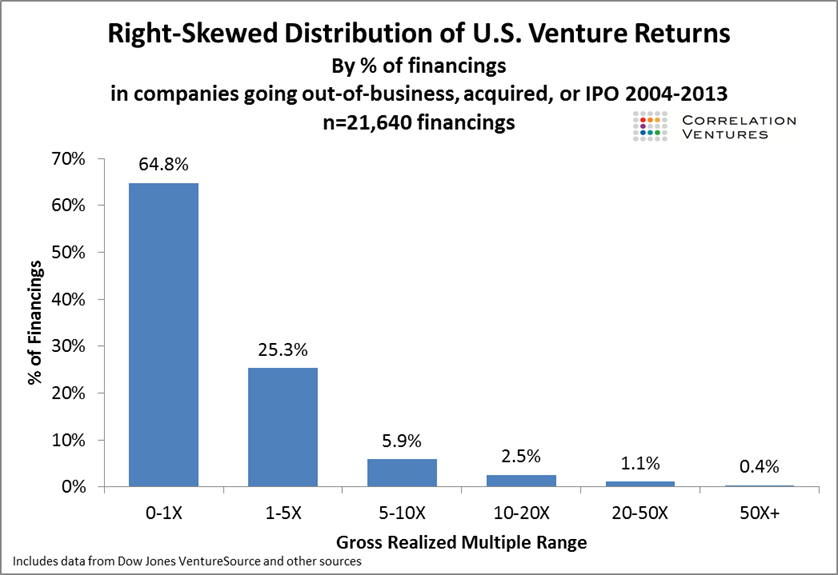
So about two out of three deals lose money, and only ~4% return 10x or more. That 4% does most of the work. The average return of a venture portfolio is propped up by a handful of huge winners, and most portfolios never own one.
HOW I MODELED IT
I built a simple fund: equal check sizes, no reserves, and each company's outcome drawn independently from the distribution above. I valued each bucket near its low end, since most deals in a bucket land near the floor:
- Losers (<1x) at 0.2x. AngelList found the average money-losing deal returns −81%, and the median loser goes to zero.
- 1–5x at 2.5x, 5–10x at 7x, 10–20x at 14x, 20–50x at 30x, and 50x+ at 50x.
Then, instead of running a simulation, I calculated every possible fund outcome exactly for each portfolio size from 10 to 100 companies. That gave me the full range of results, not just one number.
THE AVERAGE NEVER MOVES
Here's the part that surprised me. The average fund returns 2.06x gross no matter how many companies you own.
The math is simple once you see it. Each dollar you invest faces the same odds whether you write one check or a hundred. A 10-company fund has fewer shots at a 50x, but each hit is worth 10x more to the fund. Those two effects cancel out exactly.
It's like betting $100 on one coin flip versus $1 on each of 100 coin flips. Same expected value. Very different experience.
THE MEDIAN DOES
The median is the outcome the typical fund actually gets: half of funds do better, half do worse. And it climbs as you add companies:
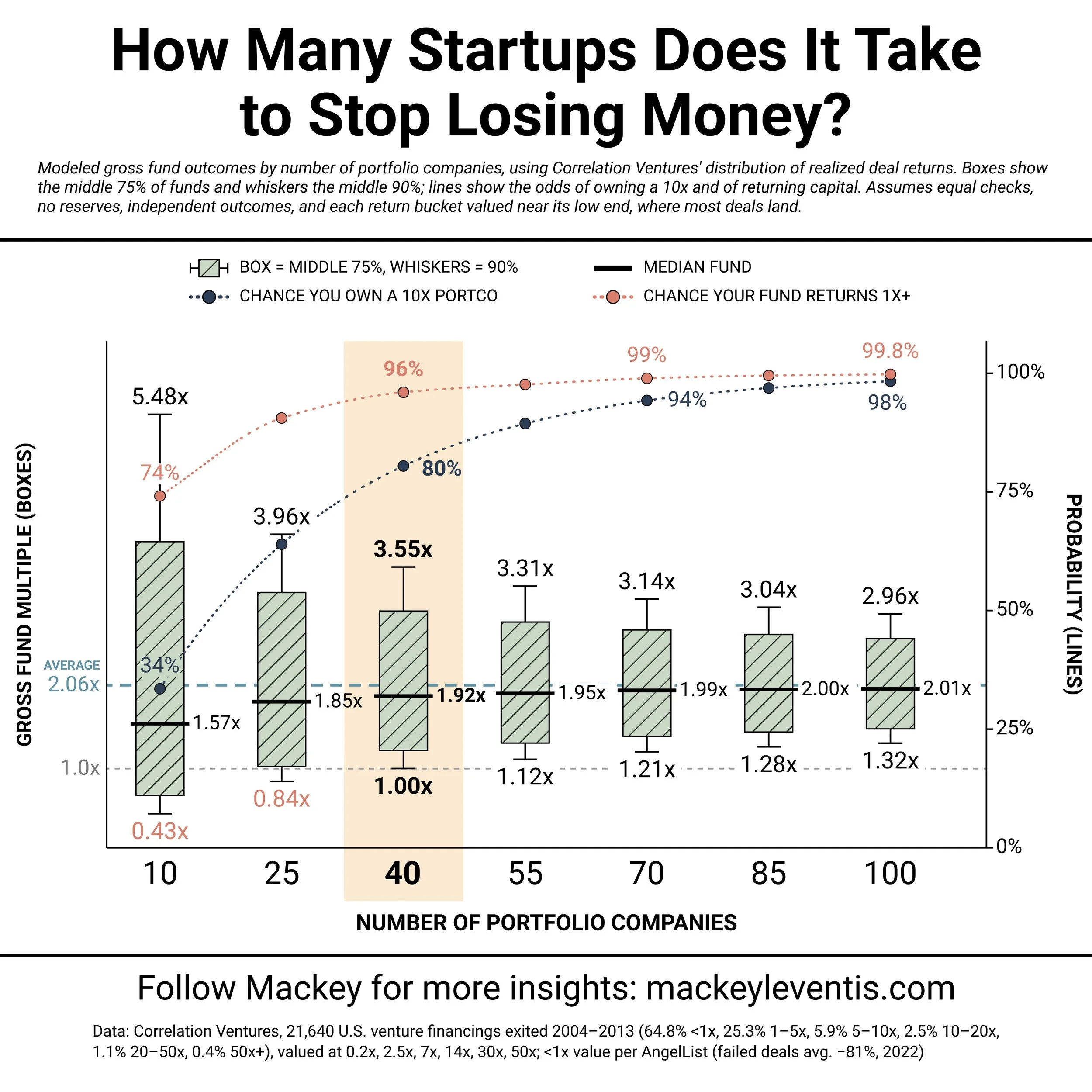
Small funds usually miss the outliers that drive the 2.06x average, so the typical small fund lands well below it. Every company you add is another shot at an outlier, which pulls your likely outcome closer to the average. That's the power law at work.
You can see it in the odds too:
- At 10 companies, you have a 34% chance of owning a 10x, and about 1 in 4 funds lose money (yikes)
- At 25, it's a 64% chance of owning a 10x, and 9% of funds lose money
- At 40, it's 80%, and even the worst 5% of funds return their capital
- At 100, it's 98%, and losing money is basically off the table (0.2%)
THE CATCH-22
Here's the tradeoff. The closer you get to the average, the more you diversify away the black swan fund.
The top 5% of funds by portfolio size:
- 10 companies: 5.5x+
- 25 companies: 4.0x+
- 40 companies: 3.5x+
- 100 companies: 3.0x+
A concentrated fund is a wider bet. More of them lose money, but the ones that hit can hit huge. A diversified fund trades that ceiling for a much higher floor. Neither is wrong. But you should know which one you're building, and so should your LPs.
WHAT THE MODEL LEAVES OUT
This is a model, not a forecast, and it simplifies a lot:
- It's gross returns. Fees and carry come out of every one of these numbers.
- It assumes your 40th deal is as good as your 10th. That's a big if. Most managers have a finite number of deals they'd truly fight for.
- It ignores check size. At a fixed fund size, more companies means smaller checks, less ownership, and maybe worse access. AUM matters.
- It ignores reserves. Real funds double down on their winners, which changes the math.
- It assumes outcomes are independent. In reality, deals from the same vintage rise and fall together, which makes the range wider than shown here.
- The data covers exits from 2004–2013. Every era is a little different.
The strongest counterargument comes from Abe Othman at AngelList, who recently argued you can't passively "index" seed. If your money is what makes a round close, you're funding deals that wouldn't otherwise get funded. And if you only join rounds that close anyway, the hottest deals give you the smallest allocations. I think he's right. You can't skip picking. But he also notes that two of the best seed investors he's seen, Naval Ravikant and Charlie Songhurst, built portfolios of 1,000+ startups. Picking and breadth aren't opposites.
SO WHAT'S THE RIGHT NUMBER?
Setting AUM aside, I think the sweet spot is 40–60 companies.
That's where the curves start to flatten. By 40 companies, you have an 80% chance of owning a 10x, a 96% chance of returning capital, and a median within 7% of the average. Going from 40 to 100 companies only buys you a few more points on each, while your top-end outcome keeps shrinking.
Below 40, you're making a concentrated bet, which is fine if that's the plan and you have the edge to back it up. Above 60, you're mostly paying for certainty you already had.
The average venture fund doesn't exist. But with enough portfolio companies, you can get pretty close.
------------------------------------------------------------------------------------------------------------------------------------------------------------------------------------------------------------------------
Sources:
Correlation Ventures, "Right-Skewed Distribution of U.S. Venture Returns" (21,640 financings exited 2004–2013), via Seth Levine, "Venture Outcomes are Even More Skewed Than You Think" (2014)
Abe Othman, "How Much Can You Lose on a Failed Startup Investment?" AngelList (2022)
Abe Othman, "The Impossibility of 'Indexing' Seed," AngelList (Sept 2026)
Model: exact distribution of equal-weight fund outcomes; buckets valued at 0.2x, 2.5x, 7x, 14x, 30x, 50x
