What Reviewing My Angel Portfolio Taught Me About Herd Mentality, Momentum, and “Youthful Alpha”
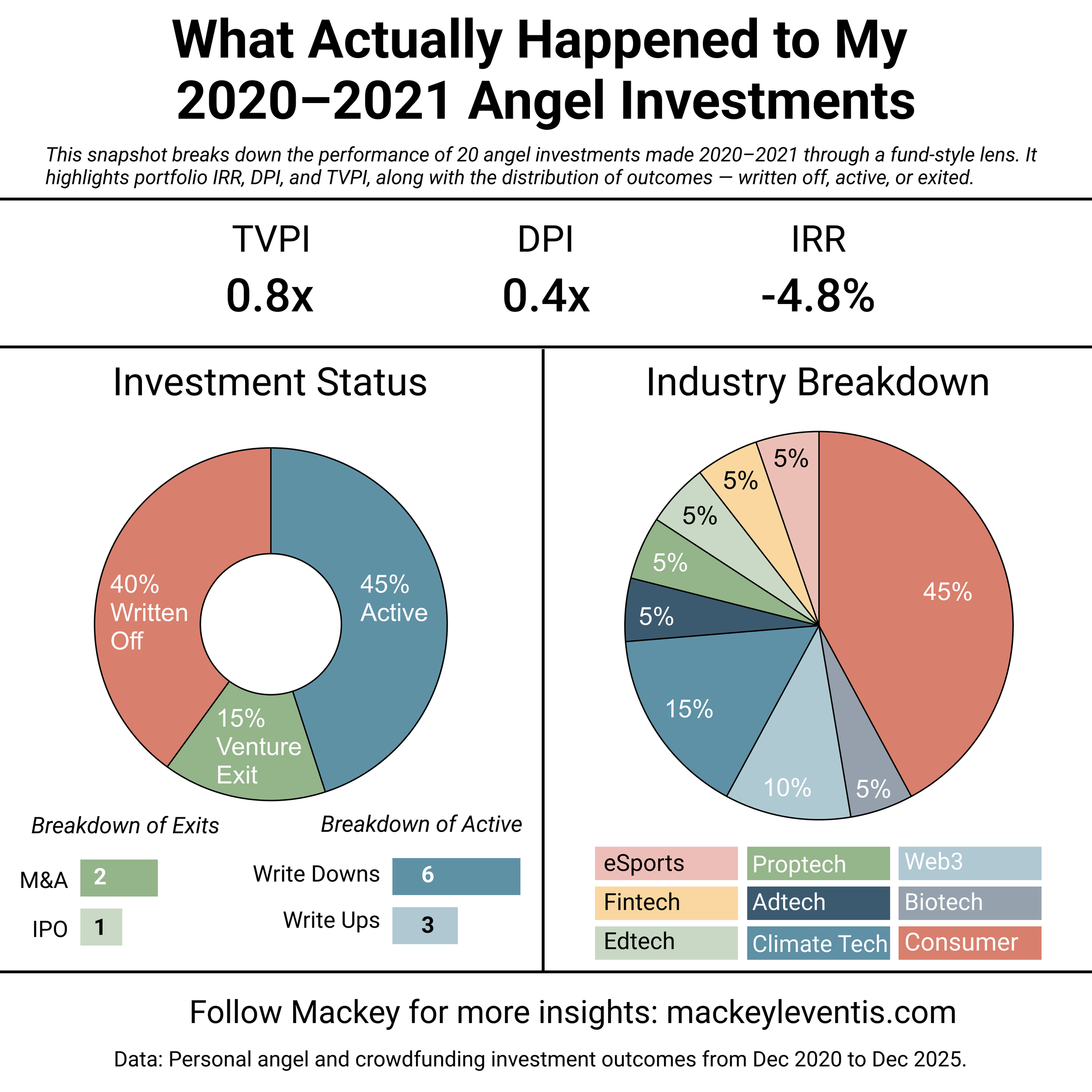
I treated my angel investing like a mini-VC fund, and while the returns aren’t the 10x MOIC I once imagined, reviewing the portfolio taught me far more than the numbers themselves. In many ways, I learned more about myself than about the companies.
When I looked back at the 20 investments I made between 2020–2021, the biggest lesson was how hard it is to avoid herd mentality in venture. Even with valuations top of mind, I still got swept up in the lockdown-era hype — plant-based everything, on-demand everything, all the categories that felt like they had unstoppable momentum. Some investments were traditional angel checks; others were crowdfunding deals on Republic. Either way, I convinced myself that “everyone” moving toward these trends must have seen something real.
But herd mentality is dangerous because it’s incredibly difficult to tell whether you’re early to a true trend or simply absorbing narratives that are subtly nudging you again and again. And the more content we consume, the harder it becomes to distinguish authentic signal from manufactured noise.
How Do You Know If You’re Early?
One of the hardest lessons in both public and private markets is learning to separate ideas that could generate momentum from ideas where momentum is already fully priced in. If most people are already talking about it — you’re not early. You’re momentum-chasing.
This distinction reminded me of one of my favorite books: Laughing at Wall Street by Chris Camillo, which is all about spotting real-world behavioral shifts long before they show up in markets. He talks about noticing the small cues — a product disappearing from the corner store, kids in a neighborhood all wearing the same thing, a sudden shift in what people talk about casually. These micro-signals often emerge long before institutional investors notice.
And honestly, younger people tend to pick up on these patterns first.
Youthful Alpha — Why The Next Generation Spots Trends Before Markets Do
When I was twelve years old, I was gifted an iPod for my birthday. I was obsessed. I explored every feature, including the stocks app, and immediately asked my mom what “stocks” were. She explained they were a way to own part of a company — and I became fixated on Apple.
I watched every Steve Jobs keynote. I begged my family to buy shares. Eventually, using all my lemonade-stand money, I bought Apple stock. A few relatives followed my lead — not because they thought I had some investment expertise, but because I was clearly noticing something many adults weren’t.
Younger generations spend hours together every day, talking about what’s new, what’s exciting, what they’re obsessed with. Even if they aren’t buyers yet, their collective attention is a leading indicator of future mainstream adoption. That mindshare doesn’t show up in revenue, doesn’t show up in KPIs, and certainly doesn’t get priced into earnings models.
But it’s real.
And over time, it compounds.
Public markets occasionally miss this. Semi-strong efficiency holds — until it doesn’t, especially when youth-driven trends haven’t yet converted to transactions.
I call this Youthful Alpha: the idea that attention from younger generations signals cultural momentum before the financials do.
Why Private Markets Struggle Even More With Trend Timing
Private markets, however, work differently. Because valuations aren’t constantly updated, they can swing wildly based on narratives — often far beyond what can be justified by fundamentals or any form of youthful alpha.
In 2020–2021, many categories saw valuations that outpaced reality:
Too much capital chasing too few deals
Hype cycles moving faster than diligence cycles
Founders raising at valuations that assumed future dominance, not present performance
And unlike the public markets, there is no mechanism to easily correct these mispricings. Once valuations stretch beyond reason, there’s often no recovery:
Even if a company raises follow-on rounds, dilution eats returns
Flat or down rounds can erase expected upside
Failing to hit aggressive growth expectations leaves investors stuck in suboptimal outcomes
In public markets, you can exit a bad position.
In private markets, you often just… wait.
A long time.
Sometimes for zero.
The Real Lesson From My 2020–2021 Portfolio
After revisiting the performance of my angel portfolio — the exits, the write-offs, the write-downs, the modest wins — one idea crystallized more than anything else:
Being early means believing in something before the world notices, not after momentum has already blinded you.
If the idea already has hype, attention, and social validation, then the upside is, by definition, priced in. You don’t make outsized returns by following momentum — you make them by seeing momentum before it exists.
Sometimes that means listening to twelve-year-olds.
Sometimes that means noticing a product missing from a bodega shelf.
Sometimes that means trusting your intuition when nothing in the narrative is telling you to.
And sometimes?
It means ignoring the herd entirely.
